Enter your household size to calculate all three legally recognized income strategies for the Spain DNV — and see which minimizes your Spanish tax exposure.
Spain Digital Nomad Visa Income Requirements 2026
Current as of June 2026
The Digital Nomad Visa (DNV) — formally the autorización de teletrabajo de carácter internacional (international remote-work authorization) — is Spain's residency permit for location-independent workers. The income threshold depends on household size and can be met through one of three legally recognized routes:
Route 1. Full-family income — from €2,849/mo for a solo applicant to ~€4,630/mo for a family of four (threshold increases with each additional member).
Route 2. Family Cap — a fixed €40,000/year ceiling for family applications of two or more people.
Route 3. €2,849/mo income for yourself plus a tax-free bank savings deposit covering dependants.
↓ Use the calculator to get the figures for your household. A full breakdown of each route, 2026 SMI numbers, and legal references are below.
⚠️
Law vs. field practice. Below are all three routes as written in Ley 14/2013 and implementing regulations. In practice, UGE-CE and consulate decisions may vary: requirements are sometimes relaxed, sometimes applied more strictly, and internal guidance shifts periodically.
Our track record. The EspañaGo team has been handling DNV applications since the visa launched in 2023 — to date, 400+ cases have been approved through us. The figures below draw on both the letter of the law and current UGE-CE practice. Official UGE-CE guidance for teletrabajadores (remote workers): ES · EN.
This content reflects the rules as of the date shown above. To review your specific situation, message us on WhatsApp or email hello@espanago.com — we reply personally and assess your case based on your actual documents.
Your Household
Adultsincluding applicant
1
Childrenunder 18
0
💡
…
All amounts in EUR (source of truth). USD/GBP equivalents are approximate and FX-dependent — check current rates at the ECB.
Three Ways to Meet the DNV Income Requirement
In practice, there are three legally recognized strategies for satisfying the financial-means requirement of the Spanish Digital Nomad Visa. All three are accepted by the Spanish immigration authority when applying from within Spain (UGE-CE — the unit that processes DNV applications). The key difference is how much income you actually need to demonstrate and what your tax exposure will be after obtaining your residency permit.
Route 1. Full Income — Covering All Family Members
The primary applicant demonstrates income that fully covers the legal threshold for the entire household. For a family of four, that means proving €4,630/mo (approximately €55,560/year). This is the most straightforward option: the immigration authority sees a clear, regular income stream from one employer (for employed applicants) or from multiple clients (for autónomo — self-employed applicants), and there are no questions about financial capacity.
Minimum income by household size (gross, before tax):
Household size
€/month
€/year
% of SMI
Solo applicant
€2,849
€34,188
200%
+ 1 dependant (total 2)
€3,918
€47,016
275%
+ 2 dependants (total 3)
€4,274
€51,288
300%
+ each additional member
+ €356
+ €4,272
+ 25%
Calculated from SMI 2026 = €17,094/year (€1,424.50/mo × 12), set by Real Decreto 126/2026. Figures update automatically at each annual SMI indexation. USD/GBP equivalents: approximate at current exchange rates — do not use hardcoded conversions.
Downside: the full declared amount falls within the scope of Spanish income tax (IRPF) and social security contributions. The more you declare, the higher your Spanish tax liability.
Advantage: if you plan to apply for a mortgage or personal loan in Spain, banks require a high declared income. Route 1 gives you the strongest tax return — this simplifies loan approval and may secure a better rate.
Best for: applicants with high, stable income who are comfortable paying Spanish taxes on the full amount, or solo applicants who prefer a clean, single-document approach. Also ideal for anyone planning a Spanish mortgage in the near future.
Route 2. Family Cap — €40,000/year (Officially Confirmed for Families)
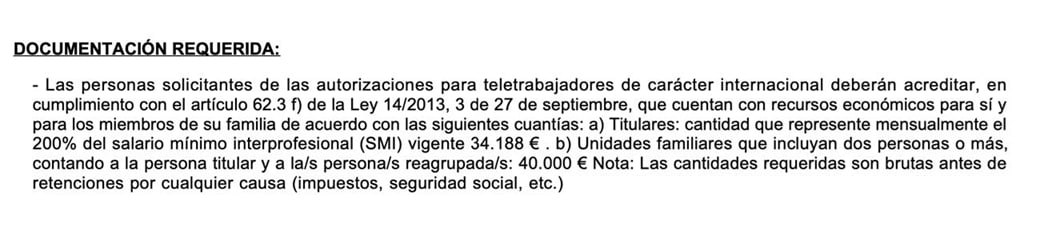
For a family application (two or more people including the applicant), it is permissible to demonstrate €40,000/year regardless of household size. This cap acts as a ceiling for family applications: it is lower than Route 1's requirement for three or more people and is especially advantageous for larger households.
That works out to approximately €3,333/mo. For a family of four — where Route 1 would require €4,630/mo — €3,333/mo is sufficient. Income is evidenced in the standard way: employer letter, employment contract, tax returns, and bank statements.
Evidence of the €40,000 threshold. Excerpt from a UGE-CE supplemental request (requerimiento) — the Spanish Ministry of Labour unit that processes DNV applications filed in Spain. The document explicitly states that for a family application (2+ people) the required annual income is €40,000, citing Art. 62.3 f) of Ley 14/2013. The SMI figure referenced in the requerimiento (€34,188) is 200% SMI for a solo applicant.
Downside: €40,000 is declared — that is the income figure the immigration authority will see. Not available for solo applications.
Best for: families of three or more where the applicant earns in the range of €3,333–€4,600/mo.
Route 3. Income for Yourself + Deposit for Dependants ⭐
The most accessible route in terms of the income amount you need to show. The applicant declares only 200% SMI for themselves — a fixed €2,849/mo. The gap between Route 1's threshold and the solo figure is bridged by a bank savings deposit — a lump sum equal to 36 months of the monthly shortfall (3 years).
Example for a family of three: Route 1 threshold is €4,274/mo, deficit is €1,425/mo, required deposit is €51,300. This amount sits in the applicant's or family's account; you may use the funds, but the balance must be present at the time of application.
Advantage: the deposit held in your bank account is not treated as income — it is not subject to IRPF or social security contributions. Spain taxes residents on their actual income: if your sole income is ~€2,849/mo, your tax liability will be minimal. Route 1 requires you to earn more — and pay tax on that larger amount.
Important note on Spanish tax residency: spending more than 183 days per year in Spain triggers tax residency, meaning Spain taxes your worldwide income (IRPF) — including any sources beyond your declared DNV income (a second job, rental income, dividends, investment gains). Route 3 delivers the most benefit when your real total income is approximately equal to the declared minimum. Informational only — not tax advice. Consult a qualified tax adviser for your specific situation.
Best for: applicants with savings whose primary income is close to the minimum. Particularly advantageous for families of three or more.
💼 How Much Deposit Does Your Household Need?synced with calculator above ↑
Required income (legal threshold)€2,849/mo
Deficit (= threshold − €2,849)€0/mo
Required deposit (× 36 mo)— not required
For a solo applicant, no deposit is required — just demonstrate income of €2,849/mo.
Comparing the Three Routes
Parameter
Full Income
Family Cap
Income + Deposit ⭐
What to prove
Threshold for entire family
€40,000/year
€2,849/mo + deposit
Available to solo applicant
Yes
No (2+ people)
Yes (no deposit needed)
Bank deposit required
Not required
Not required
36 × monthly deficit
Spanish tax base
Full declared income
€40,000/year
Your actual income (if close to minimum, tax liability is minimal)
Tax burden
Highest
Moderate
Lowest
Scales with family size
Increases per member
Fixed from 2+
Deposit grows; income stays fixed
Tax residency note: 183+ days/year in Spain = Spanish tax residency triggered. All tax references are informational only — not tax advice.
Quick Answers
What income is required for the Spain Digital Nomad Visa in 2026?
For a solo applicant: €2,849/mo (200% of SMI, or €34,188/year). Family members add further SMI multiples: 275% for two people total, 300% for three, +25% per additional member. Use the calculator above to get the figure for your household.
Can I get the Spain Digital Nomad Visa with a lower income?
Yes. Under Route 3, the applicant demonstrates income only for themselves (€2,849/mo), and the shortfall for dependants is covered by a bank savings deposit — equal to 36 months of the deficit. Families can also use Route 2 — a fixed cap of €40,000/year.
How long are these figures valid?
For 2026. The SMI (Salario Mínimo Interprofesional — minimum interprofessional salary) is set each year by royal decree. Real Decreto 126/2026 is in force from 1 January to 31 December 2026. When the next indexation is announced, the figures here will update accordingly.
Is the income calculated gross or net?
Gross (before tax). This is stated explicitly in UGE-CE supplemental requests: «cantidades requeridas son brutas antes de retenciones por cualquier causa (impuestos, seguridad social, etc.)» — the required amounts are gross, before any deductions. All figures in the calculator and tables above are gross. Compare against your own gross income: for employment, that is your pre-tax contract salary; for autónomo (self-employed), that is total receipts before business expenses.
Does income from multiple clients count?
For autónomo (self-employed) applicants: yes, income from multiple clients can be combined. For employed applicants: the DNV income is demonstrated through a single employer's documentation.
What is the minimum deposit required under Route 3?
It depends on household size. For a solo applicant: no deposit required. For two: €38,484. For three: €51,300. For four: €64,116. Use the interactive widget above for your exact figure.
What if my income is below the €2,849/mo minimum?
In our experience, approvals have been issued with incomes 10–15% below the formal threshold — provided the shortfall was covered by a bank deposit using the same Route 3 logic (× 36 months). For example, at €2,500/mo instead of €2,849/mo, a deposit of €349 × 36 ≈ €12,600 may bridge the gap. This is not a guarantee — each case is assessed individually — but it is a viable approach. Contact us and we will review your situation.
For employed applicants, income is evidenced through a single employer — using an employer letter, employment contract, and bank statements. For autónomo (self-employed) applicants, income from multiple clients may be combined: what matters is the total received over the period, not the number of sources.